How to optimize your parameters for fiber laser marking

Fiber laser marking machines are among the latest innovations in laser technology. They offer a number of advantages over CO2 lasers, especially when it comes to metal engraving. However, achieving the results your machine is capable of requires careful attention to your fiber laser marking parameters.
The importance of optimizing parameters for high-quality results
When working with any type of laser cutting, engraving, or marking machine, it is crucial to set the parameters correctly. This is especially true when using a fiber laser engraving machine.
Fiber laser technology uses high-quality laser beams and optical components to achieve a small focal spot diameter. This small focal spot diameter improves the precision of the fiber laser marker and concentrates the laser energy to enable engraving and marking on a wide range of materials.
Without suitable parameters for the fiber laser, there is a high chance that you will lack the precision required for small, complex designs. Precision is needed for a variety of things: sports medals, trophies, commemorative plaques, and other similar decorative metal items all require incredible accuracy for their text and details.
As a general warning, there is also less leeway when working with a fiber laser marking machine compared to CO2 lasers. While CO2 lasers often work with organic materials and other soft surfaces that do not require exceptional precision, engraving metals and other hard surfaces with a fiber laser requires fine-tuning your machine.
Important procedures for optimizing laser marking parameters
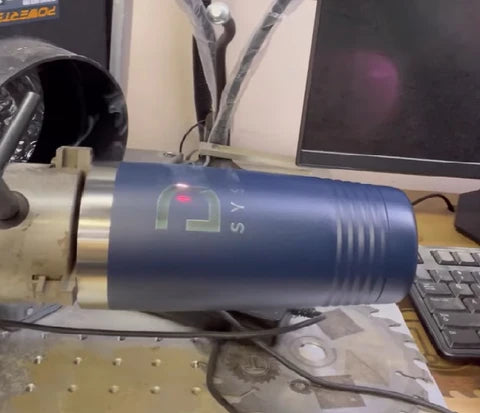
Knowing your machine and the materials you are working with is critical to optimizing laser beam parameters. Before you begin a laser marking project, familiarize yourself with the settings of the OMTech laser to understand the factors that will influence your results. These key parameters all play an essential role.
Improve laser power settings
Power is one of the most critical parameters for laser engraving. Your fiber laser marking machine has a specific maximum power output. It can be adjusted to output any value up to this maximum. The higher the power, the more material your laser will remove with each pass.
There is no one-size-fits-all solution for power. Instead, you need the right power level for the specific material you are using and the depth of your markings. You also need to balance power and the number of passes. Higher power means fewer passes, but increases the risk of damaging your piece.
Adjust marking speeds for efficient work
Your laser marking machine moves the laser beam along a predetermined path at a certain speed. The slower the speed, the longer the laser is in contact with the surface. At a given power setting, this results in a deeper mark. A higher speed setting means that your project will be completed faster, but you may need a higher marking quality.
The speed depends mainly on the materials. Softer metals such as aluminum allow for faster passes. Harder metals such as brass and stainless steel may require a significantly reduced speed to ensure that your markings are clearly visible. You may also need higher power settings, but there is only so much that can be compensated for.
Select the appropriate resolution and frequency
Whenever you start a new project, you should first determine the appropriate resolution and frequency. The resolution affects the detail in your design. The resolution determines how smooth your design will look and how small the finest details can be.
Frequency is another important factor. Your fiber laser marking machine does not use a continuous beam, as this could damage both the material and the equipment. Instead, it emits regular pulses at a set frequency. The choice of pulse frequency is another essential parameter for laser marking.
Choose the right resolution for your design
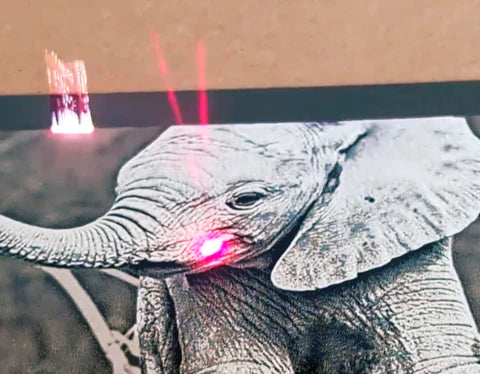
Different resolutions have a significant impact on both your final results and the time your project takes. Fiber lasers can achieve higher resolutions than CO2 lasers. However, there are many factors to consider when choosing the resolution for a particular design. In general, the metals most commonly used with fiber lasers allow for a resolution of 600 to 1,000 DPI.
A simple design such as a logo or larger text does not require high resolution. You can achieve beautiful results much faster at lower resolutions. However, detailed designs such as complex graphics or photorealistic markings require higher resolutions, which take more time.
Adjust frequency based on material properties
A lower frequency means that your laser is switched on and off less frequently and emits more energy with each pulse. Lower frequencies vaporize materials, while higher frequencies are better suited for creating an oxide layer.
Manage passes, air assist, and Z-offset
Several other important parameters can have a major impact on your results. The number of passes is crucial for the depth of a mark. More passes mean more depth, although you need to balance passes with speed and power.
Air assist provides a continuous airflow that blows away debris during the laser engraving process. While this is more important for softer materials and deeper cuts, it also helps reduce spatter and charring during metal engraving. Make sure your air assist is enabled.
The Z-offset measures the distance between the focal length of the laser and the surface of the material. The laser beam is concentrated at its focal point with the highest power. Typically, you want to set the Z-offset so that the focal point is between the surface and the intended engraving depth.
The precise marking capabilities of OMTech fiber laser machines
Carefully optimizing parameters for fiber laser marking is crucial to achieving the stunning results you want for your next piece. However, the specific equipment you choose is equally important. If you're not working with the right tools, no amount of troubleshooting will yield results. OMTech offers a wide range of laser marking, engraving, and cutting machines. This includes the latest fiber laser machines for exceptional results with a variety of materials. You can browse our collection right now to find the right fiber laser marking machine for every application.
Comments
0 comments
Please sign in to leave a comment.